 Sample Offer Attraction Pack · Marcus R.
What unlocks at $97.
A curated slice of Marcus's pack — the hireability page he walks into rooms with, the buyer he's actually serving, and the Founder Path landing-page strategy he runs on the side.
Decide your direction so it is never decided for you.
Your assets are ready. The next 30 days decide which path your market pulls you toward. Use the playbook as evidence-gathering, not homework.
The story of de-risking legacy migrations for vertical SaaS CPOs.
When to use: Send when a recruiter asks why you left your last role.
The story of mapping undocumented code for field service founders.
When to use: Send when a prospective client asks how your advisory practice works.
Your chronological proof of migrating Backbone to React safely.
When to use: Submit to ATS portals for Director of AI Product Strategy roles.
Your public-facing modernization advisor profile and posting cadence.
When to use: Deploy immediately to signal your specific expertise to the market.
Your digital portfolio proving you cut dispatch times and protect revenue.
When to use: Link in cold emails to hiring managers to bypass the resume pile.
The exact psychological profile of the bootstrapped field service buyer.
When to use: Review before drafting any outreach to potential advisory clients.
The mechanism and offer for your Rapid Legacy Discovery Blueprint.
When to use: Send to a buyer after they agree to a discovery call.
Publish Authority Amplification (LinkedIn) updates and pin your featured seed post.
Submit Résumé ReVector to three target Director of AI Product Strategy roles.
DM two hiring managers at target vertical SaaS companies using Script 1.
Send warm-intro requests to two mutual contacts using Script 2.
Review the Operator Path narrative to refine your interview answers for next week.
Publish the first post from your Authority Amplification kickstart pack.
Cold email three recruiters at target vertical SaaS companies using Script 3.
DM two more hiring managers using Script 1, linking the Premium Positioning Page.
Publish the second post from your Authority Amplification kickstart pack.
Follow up with any hiring managers who opened your messages using Script 5.
Publish the third post from your Authority Amplification kickstart pack.
Submit Résumé ReVector to three newly posted product leadership roles.
Send warm-intro requests to three new mutual contacts using Script 2.
Publish the fourth post from your Authority Amplification kickstart pack.
Send Script 6 to any misaligned roles to keep the door open for future opportunities.
Publish the final post from your Authority Amplification kickstart pack.
Cold email three more recruiters using Script 3.
Follow up on all active conversations using Script 5 to secure interview next steps.
Review your Premium Positioning Page analytics to see which case studies get traction.
Evaluate your interview pipeline and decide if you need to adjust your target company list.
- Update LinkedIn headline and About section using the rewrite15 minAuthority Amplification (LinkedIn)
- Extract the cover letter hook from the signature line to use in warm introductions10 minRésumé ReVector
- Read the buyer bio and pain points to internalize the exact fears of your target client20 minYour Ideal Client
- Review the case studies to memorize your quantified outcomes for upcoming interviews15 minPremium Positioning Page (Hireability)
- Draft a list of ten target companies that match the profile of your ideal buyer30 minFounder-launch Landing Page
- Practice reciting the hook and closing line out loud to build narrative muscle memory10 minOperator Path narrative
Submit your chronological document to the ATS portal, then immediately DM the hiring manager with a link to your digital portfolio to bypass the automated filter.
Read the buyer's biggest fear of botched migrations, then use the exact language from the mechanism section to draft a highly targeted cold email.
Use the daily routine anchor from your story as the opening hook for a new LinkedIn post, driving readers to your featured seed post.
When a prospect replies to your cold outreach, send them a link to your latest contrarian take post to prove your domain expertise before the discovery call.
- Pitching generic product management to a Founder and CEO.
Why it backfires: Bootstrapped field service founders are terrified of botched migrations. If you sound like a generic ticket-writer, they will assume you will break their active revenue engine.
- Leading with AI tools instead of operational reality.
Why it backfires: The buyer does not care about your automated logic extraction; they care that you cut dispatch times from 6.5 to 2.1 minutes. Leading with the tool neuters your Premium Positioning Page.
- Suggesting a feature freeze to rebuild the core.
Why it backfires: This triggers the exact fear outlined in the profile of your ideal client. Suggesting downtime instantly poisons the conversation and disqualifies your Founder-launch Landing Page offer.
- Sending the chronological document to a consulting prospect.
Why it backfires: Sending the Résumé ReVector to an advisory buyer frames you as a job seeker rather than a practice owner, completely undermining the authority of your Founder Path narrative.
I help private-equity-backed vertical SaaS CPOs Scope, Sequence, and Ship legacy core migrations without breaking the workflows that pay the bills.
While most product teams freeze the revenue engine to rebuild the core, I turn outdated codebases into modern systems that expand margins on your current hold cycle.
I use advanced logic extraction to parse your outdated codebases and document the exact permissioning rules currently keeping your customers online, cutting the traditional discovery phase in half.
I designed a usage-based pricing model on top of a newly modernized infrastructure that generated fourteen million dollars in net new annual revenue without increasing engineering headcount.
I rebuilt a core dispatcher console from a ten-year-old framework to a modern stack, reducing average dispatch time by sixty-eight percent for three hundred and forty active customers while maintaining full operational uptime.
I led the migration of a 2014-era legacy application to a modern framework by mapping the undocumented operational workflows before engineering began the rewrite.
I translated the time saved from our core system modernization into a hybrid pricing model that captured consumption-based upside for the business.
I designed an enterprise-grade infrastructure and permissioning model that successfully survived a company acquisition and became the foundation for a new product line.

Elena Rostova
Elena built a profitable field service platform that hundreds of HVAC and plumbing contractors rely on daily, but the decade-old codebase is now buckling under its own weight. She knows they must rebuild the core to unlock new pricing tiers, but she is terrified a botched migration will flatline their active revenue. She is trying to chart a modernization course that doesn't burn out her lean engineering team or force her to take predatory outside capital just to survive the transition.
What Elena needs most is the revenue expansion required to fund their next growth phase without taking the private equity capital she swore to her co-founder they would never accept. Outreach that names a clear path to protecting her bootstrapped margins during a technical rebuild lands; outreach that promises generic growth reads as naive to the risks of a legacy rewrite.
Elena needs to feel safe before she can feel supported—outreach that opens by acknowledging the massive risk of breaking her active revenue engine immediately earns her trust. Once that safety is established, framing your advisory as the exact architectural guidance her small engineering team is missing proves she won't have to navigate this transition alone.
- Losing larger enterprise contracts because the aging dispatcher console cannot support the complex permissioning those clients require
- Watching engineering morale plummet as her small team spends all their cycles patching legacy bugs instead of shipping the new features that drive expansion revenue
- Bleeding gross margin because the current architecture physically cannot support the hybrid, usage-based pricing models her competitors are rolling out
- A guaranteed, phased roadmap that modernizes the core platform without a single minute of downtime for their active customer base
- The ability to confidently roll out new, high-margin pricing tiers tied to actual operational efficiency gains
- The relief of knowing her engineering team is executing a proven architectural blueprint rather than guessing in the dark
That initiating a core system rewrite will break the exact dispatch workflows that generate their current revenue, killing the company she spent a decade building.
A modernized, highly profitable platform running on a clean stack, allowing her team to ship new features rapidly while she retains total ownership of a growing, high-margin business.
She needs to feel absolute certainty that her platform's modernization won't destroy her life's work or force her to sell the company under duress.
- A major legacy customer threatens to churn because the system is too slow to handle their peak-season dispatch volume
- Her lead engineer threatens to quit, citing the exhaustion of maintaining a decade-old, undocumented codebase
- She sits down to model next year's growth and realizes the current pricing structure mathematically caps their revenue, but the system cannot support a change
I help private-equity-backed vertical SaaS CPOs Scope, Sequence, and Ship legacy core migrations without breaking the workflows that pay the bills.
While most product teams freeze the revenue engine to rebuild the core, I turn outdated codebases into modern systems that expand margins on your current hold cycle.
The legacy rebuild that breaks your current revenue engine
- The lead engineer threatening to walk away
Your small team spends every cycle patching a decade old undocumented codebase. They are exhausted from fixing bugs instead of shipping the features that drive margin expansion.
- The enterprise contract you cannot sign today
A major customer needs complex permissioning your aging dispatcher console physically cannot support. You are watching high margin deals walk away because the architecture is stuck in the past.
- The pricing model capping your next year
You want to roll out hybrid usage based pricing to charge for the value you deliver. Your current infrastructure mathematically prevents you from billing for actual operational efficiency gains.
I map and sequence your legacy core migration using automated discovery grounded in field service operational reality.
We do not guess what your decade old code is doing. I use specialized workflow analysis to extract the exact business logic and multi tenant permissioning rules hidden in your current system. This creates a phased architectural blueprint your small engineering team can execute safely without risking a single minute of downtime for your active customer base.
- Automated legacy logic extraction
- Phased architectural migration blueprints
- Dispatcher workflow friction analysis
- Margin expansion pricing models
A modernized platform running on a clean stack that actively expands your gross margins.
You stop bleeding engineering cycles on technical debt and start shipping the features that win enterprise contracts. Your team executes a proven roadmap that protects your active revenue while transitioning your core system to support the high margin pricing tiers your competitors are already using.
- Zero downtime for active users
- Protected enterprise valuation
- Accelerated feature shipping velocity
- Usage based revenue expansion
“Won't a core system rewrite force us to pause new feature development?”
No. The phased blueprint isolates the legacy migration from your active revenue engine. Your team continues shipping critical updates while we systematically replace the underlying architecture piece by piece.
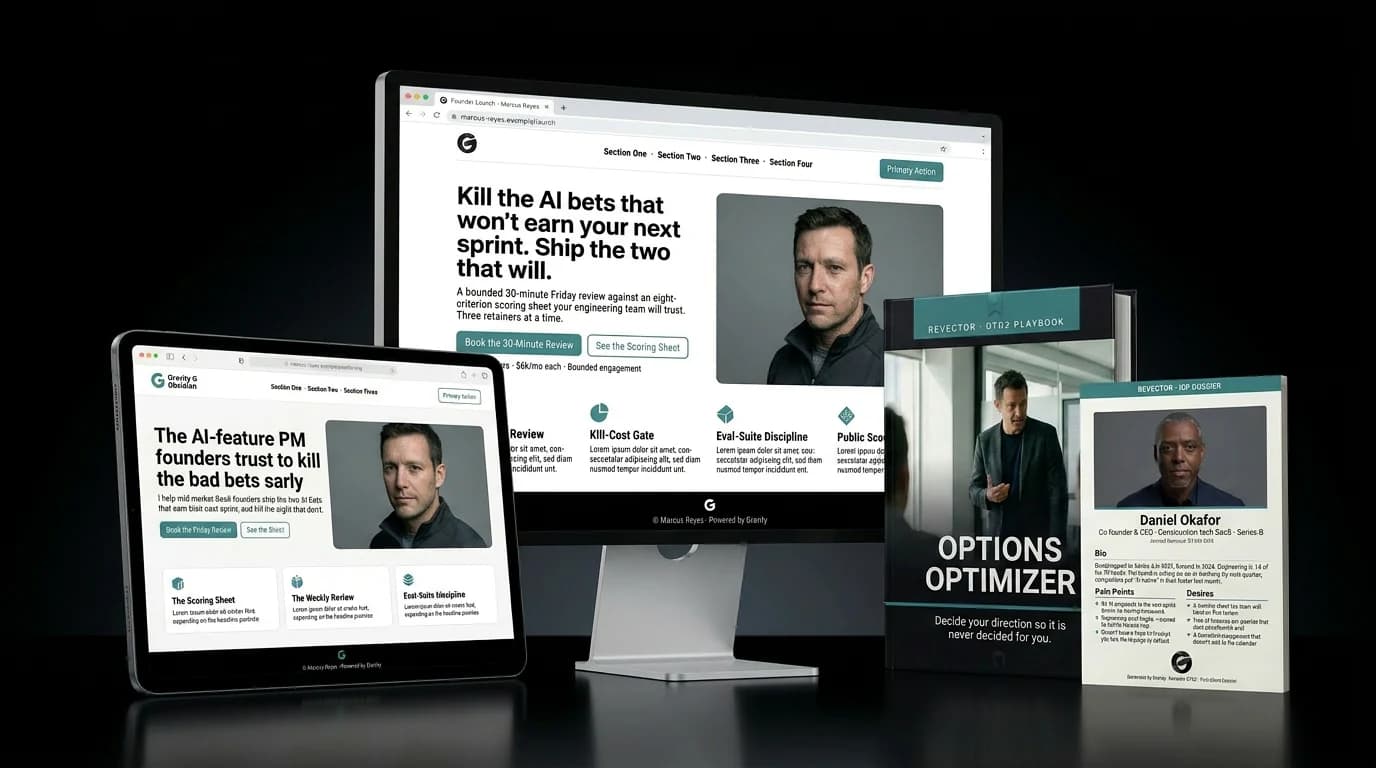
This is what your own Offer Attraction Pack looks like.
Built from your résumé and the live market read. Same depth, your buyer.
Get my $97 upgrade