 Sample Pivot Powerplay Pack · Marcus R.
The 30-day visibility calendar + two A/B-ready landing pages.
Built around Marcus's Founder Path — the AI-bet review consultancy his moat actually supports. A curated slice of the full pack: five featured days from the month, both landing-page variants in full.
Fast-forward the future version of yourself starting now.
The orchestration playbook for your thirty-day calendar plus two landing pages. What feeds what, what to ship Monday morning, and how to read the signal from the noise.
“I will instruct you and teach you in the way you should go; I will counsel you with my eye upon you.” — Psalm 32:8
How the bundle wires together
You publish across LinkedIn, Twitter, and YouTube so your exact buyer recognizes their own operational bottlenecks in your words. The calendar earns their attention by naming the exact pain of patching legacy code, proving you understand their daily reality. The landing page then turns that earned attention into a booked conversation where they feel safe asking for your help.
You route this attention to two distinct destinations based on what your buyer needs to hear right now. The safety-framed Variant A 'The Safety Blueprint' converts the founder who fears breaking their active revenue engine, while the success-framed Variant B 'The Margin Angle' speaks to the leader ready to translate operational efficiency into margin expansion. They choose the path that matches their immediate operational anxiety.
You run this loop to build trust before the first call ever happens. The calendar earns the initial nod of agreement, and the landing page turns that silent agreement into an active request for guidance. The Founder and CEO on the other end of this interaction arrives at the call feeling understood, not pitched.
From daily hook to published post
- 01Open with the specific situation your buyer is facing right now, like losing an enterprise contract because the dispatcher console cannot handle complex permissions.
- 02Name the hidden cost of the workaround, showing them you understand how patching legacy bugs destroys engineering morale.
- 03Introduce the structural fix as a choice they can make today, rather than a massive rebuild they have to fear.
- 04Close by offering a specific proof artifact, like your migration scoring sheet, to move the conversation from public agreement to private dialogue.
Keep LinkedIn long-form posts between 600 and 900 words to give the narrative room to breathe. Twitter threads need 5 to 8 tweets to unpack a single architectural concept without losing the reader. YouTube talking-head videos hit the mark at 4 to 8 minutes, giving you enough time to sketch the solution while respecting their schedule.
- A blurred screenshot of the legacy architecture map next to the clean React state.
- A one-paragraph excerpt from your migration scoring sheet showing exactly how you measure risk.
- A simple chart comparing dispatch times before and after the workflow automation.
Publish between Tuesday and Thursday from 7 to 9 AM Pacific for LinkedIn, when founders are reviewing their operational metrics for the week. You protect this window by scheduling the week's content on Sunday evening, ensuring your presence remains steady even when your consulting work gets heavy.
Signal vs noise, and when to call it
- CTA-click rate per variant tells you which emotional framing actually makes a Founder and CEO feel safe enough to ask for help.
- Time on page reveals whether your buyer is actually reading your methodology or just skimming for a price tag.
- Qualified direct message rate shows you how many readers felt compelled to bypass the page entirely and speak to you directly.
- Raw impressions look like momentum but rarely predict whether a founder will actually book a call with you.
- Generic comments from peers outside your target industry do not pay the bills, so do not let them dictate your next post.
- Follower count growth is a vanity metric that distracts you from the actual relationships you are building in the direct messages.
Comment, DM, and move-to-call scripts
I noticed your comment about the engineering team burning out on legacy bugs. I built a short diagnostic that maps exactly where those cycles are bleeding out, happy to send it over if it helps you frame the rebuild.
Hi [CLIENT FIRST NAME], I saw you engaging with my post about the operational ceiling of technical debt. Most founders I speak with are losing enterprise contracts because their aging dispatcher console cannot support complex permissioning. I put together a brief scoring sheet that sequences a core system rebuild without pausing active revenue. Let me know if you want to take a look, no strings attached.
Glad this resonates with what you are seeing on the ground. The easiest way to figure out if this sequencing works for your specific architecture is a quick 30-minute review call. Here is my calendar link if you want to map out the first phase together.
When a post lands big, and when it doesn't
- 01Hour 0 to 2: Pin the post to your Featured section so new profile visitors see your best thinking first.
- 02Hour 2 to 4: Send a direct message to the top three Founder and CEO commenters asking how their engineering team is handling the current sprint.
- 03Hour 12 to 24: Reply to the remaining thoughtful comments with a specific question about their own dispatcher console limitations.
- 04Hour 24 to 48: Draft a follow-up post for next week that expands on the most debated point in the comment section.
- 05Hour 48: Capture the core argument of the post and add it to your permanent buyer profile notes for future sales calls.
If you can only ship three a week
You publish three times a week, anchoring on Tuesday, Wednesday, and Thursday. You rotate between a long-form post that builds your core argument, a short observation that sparks immediate agreement, and a direct message that invites a private conversation. This rhythm is sustainable because it respects your consulting hours while ensuring your exact buyer sees your pattern from multiple angles.
Establishes your core premise immediately, framing technical debt as a business ceiling rather than an engineering complaint.
Directly targets the Founder Path with a massive financial implication, feeding perfectly into the margin-focused landing page.
Draws a hard line between you and generic agencies, positioning your specific field service expertise as the only safe choice.
Names the exact plummeting morale pain point from your buyer profile, earning trust through deep empathy.
Agitates the deepest fear of your Founder and CEO buyer, driving urgent traffic to the safety-framed landing page.
Shifts the conversation from risk mitigation to pure upside, capturing the founders who are ready to expand.
Proves you understand that software features only matter when they change the customer's operating margins.
Offers a concrete pause point for founders about to make a costly mistake, positioning you as the voice of reason.
Reframes a daily annoyance into a strategic asset, showing the buyer you understand their operational reality.
Directly answers the primary objection to modernization, clearing the path for a booked conversation.
Connects the dots between operational efficiency and the Founder and CEO's dream outcome of a highly profitable platform.
Closes the month by cementing your value as the protector of their life's work and active revenue engine.
Five featured days from Marcus's month.
Content type, target surface, and path alignment for every day — so the cadence reinforces the path Marcus is committing to.
The true cost of technical debt is not maintenance, it is the operational ceiling you cannot break through.
I translate the messy operational reality of field service dispatchers into clean, high-margin software product requirements.
Founders hit a growth ceiling at conservatively $10M ARR because their aging infrastructure cannot support the complex workflows required by mid-market operations leaders.
Bootstrapped founders cannot afford a full-time enterprise product chief to oversee a massive rebuild. You need a fractional blueprint.
I provide the exact blueprint to untangle your technical debt without burning out your small engineering team.
+ 25 more days inside the pack — full daily cadence, content-type variety, and path-alignment scoring across the month.
Same offer. Two emotional triggers.
Same offer, two emotional triggers. Test which lands with your buyer.
Sequence your legacy system rebuild without pausing your active revenue.
Get a phased architectural roadmap that preserves your core business logic and keeps your small engineering team focused on shipping.
- Blind rebuilds break existing workflows. We map your undocumented business logic in days rather than months, preserving the exact operational rules your customers rely on.
- Engineering teams get stuck in discovery. We cut the discovery phase by conservatively 50 percent, handing your team clear, modern product requirements.
- Outdated pricing tiers leave money on the table. We tie your modernized infrastructure directly to margin expansion, capturing at least the value of the operational efficiency you deliver.
Over the last 12 years in mid-market B2B software, I led the rebuild of a legacy dispatcher console that cut average dispatch time from 6.5 minutes to 2.1 minutes across 340 active customers, directly contributing to a conservatively $14 million annual revenue line.
Modernize your aging software infrastructure without burning out your engineering team.
I help founder-owned vertical software companies translate the messy reality of their legacy systems into clean, modern product requirements.
- Legacy code hides your most valuable business logic. We extract the exact multi-tenant permissioning and pricing rules buried in your old system before writing a single line of new code.
- Seat-based pricing limits your growth ceiling. We structure your new product tiers to capture the actual value your users get, moving toward a hybrid model that expands margins.
- Dispatchers and field workers bypass clunky workflows. We turn chaotic daily user complaints into a structured product roadmap that directly addresses field service operational reality.
- Rebuilding the core platform stalls your current sales motion. We execute a phased migration that keeps your revenue engine running while you transition to a modern stack.
I specialize in growing field service operations platforms, previously designing the multi-tenant permissioning model that survived a company acquisition and growing an embedded analytics product to typically $4.8 million in annual revenue.
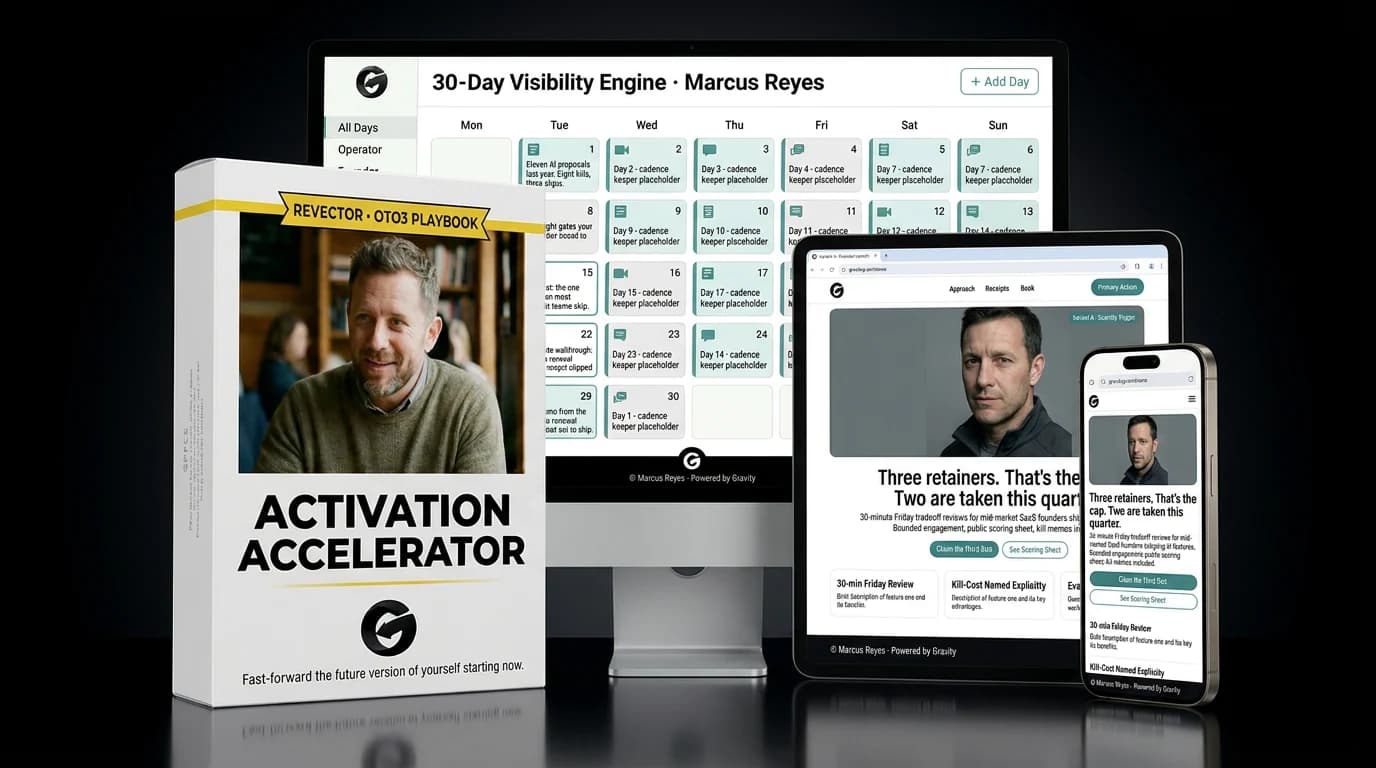
This is what your own Pivot Powerplay Pack looks like.
Thirty days of cadence + two landing pages, built from your résumé and your path.
Get my $497 upgrade